
Hyrox Race Guide 2026/27
Official format, the 8 stations, weights by division, 2026/27 rules and penalties, race day checklist and transition strategy.
By Olivier Maréchal, founder of EvoxRaced HYROX in Doubles and Solo Open (1h18)
The 8 Stations in Order, With Weights
| # | Station | Distance / reps | Open (women / men) | Pro (women / men) |
|---|---|---|---|---|
| 1 | SkiErg | 1000 m | / | / |
| 2 | Sled Push | 50 m | 102 / 152 kg | 152 / 202 kg |
| 3 | Sled Pull | 50 m | 78 / 103 kg | 103 / 153 kg |
| 4 | Burpee Broad Jumps | 80 m | / | / |
| 5 | Rowing | 1000 m | / | / |
| 6 | Farmers Carry | 200 m | 2×16 / 2×24 kg | 2×24 / 2×32 kg |
| 7 | Sandbag Lunges | 100 m | 10 / 20 kg | 20 / 30 kg |
| 8 | Wall Balls | 100 reps | 4 kg, 2.7 m / 6 kg, 3 m | 6 kg, 2.7 m / 9 kg, 3 m |
Official HYROX 2026/27 standards. A 1 km run comes before each station, and the race ends on the wall balls. Sled weights include the sled. Wall balls: ball weight, then target height. To train for these loads, see our Hyrox training guide.
What Is a Hyrox Race?
This guide mixes the official HYROX rulebook for 2026/27 with my own races. When something is a rule, I say so. When it is my opinion, it is written in the first person.
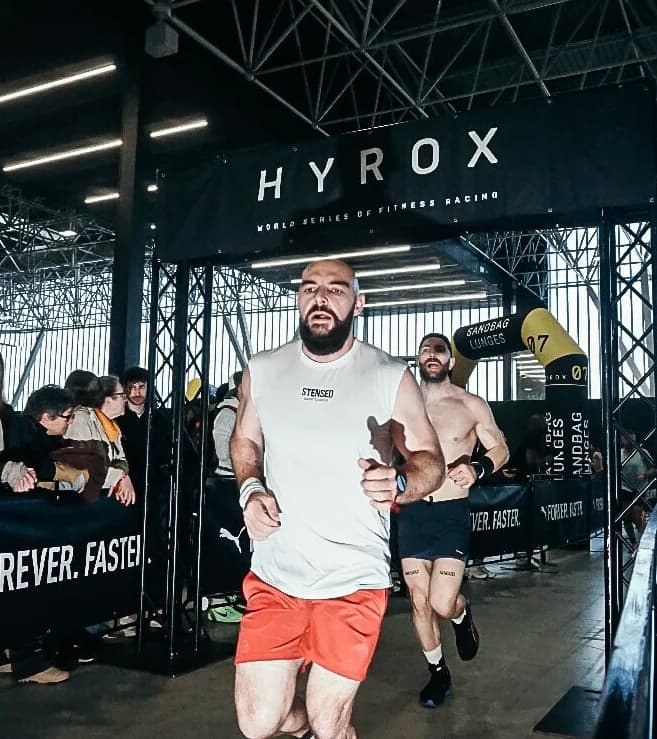
8 km of running. 8 workout stations. One clock. Hyrox uses the same format everywhere in the world: run 1 km, do a station, run 1 km, do the next one, eight times. Your score is your total time. No surprise workouts and no changing format, so you can compare a time from Paris with one from New York, or this year's with last year's.
Everything happens indoors, in convention centers and arenas: no weather, no terrain excuses. There is no time limit either: everyone who finishes gets a time. For a first Hyrox, Doubles is a good entry point: you run with a partner and split the station work freely. More on that below.
This guide covers the race format, rules, and race day logistics. For training plans and preparation, check our Hyrox training guide.
The Race Format: Step by Step
Every Hyrox race follows the same sequence: athletes start in waves, run 1 km on an indoor track, pass through the Roxzone (transition area), complete a workout station, then head back to the running track. This cycle repeats 8 times. The clock starts at your wave time and never stops until you cross the finish line after the last station.
Between every run and every station you go through the Roxzone. How to cross it quickly is covered in the transition section below.
1000m
First station after the opening 1 km run. 1000 meters of upper body pulling on a Concept2 SkiErg. Damper between 6-7 for most athletes. Find a consistent rhythm and resist the urge to sprint the first 200m. Know your pace before race day: do a 2 km SkiErg after a workout at a constant pace, and find the split that lets you perform without being too gassed. That's your target. This station taxes your lats and shoulders early, which matters for sled pull and farmers carry later.
50m, Open M: 152 kg / W: 102 kg
Push a weighted sled 50 meters along a marked lane, typically split into 4 × 12.5m sections. The weight includes the sled itself. Keep your body angle low (about 45 degrees), arms extended, short powerful steps. Important: the surface in competition is often stickier than in your gym, don't expect the sled to glide like it does in training. This station can burn your quads for the rest of the race if you go too hard. If your legs are strong, push through each 12.5m section without stopping. If legs are a weakness, break at each 12.5m mark with a quick 3-5 second pause. It's better to manage this station than to blow up and pay for it on every run and station that follows.
50m, Open M: 103 kg / W: 78 kg
Pull the sled toward you over 50 meters using a rope. The most efficient technique is NOT to pull hand over hand with your arms. Instead, grab the rope, keep it taut, lean back slightly and walk backwards. Let your bodyweight and legs do the work, not your arms and lats. If you burn out your grip and back here, you'll pay for it on the rower, farmers carry, and wall balls. Important: take a margin behind the foot line, the pulling motion can make your feet slide forward slightly, which is an avoidable penalty.
Burpee to the ground (chest touches the floor), then broad jump forward. Cover 80 meters total. Using your knees to stand up is allowed. The jump must be forward, no stepping. There are two strategies and the best one depends on your body: heavier athletes often benefit from a slower, controlled burpee with a longer jump (fewer reps to cover the distance), while lighter athletes can go faster with shorter jumps. The only way to know is to test both approaches under fatigue. Try at least 40-50m in training after a hard effort and see which one you recover from better. This station destroys your heart rate either way, so pacing matters more than speed.
1000m
1000 meters on a Concept2 rower. The halfway point of the race. Same advice as the SkiErg: know your pace beforehand by testing 2 km under fatigue at a steady split. Damper 5-7 for most. Drive through the heels, lean back to 1 o'clock, control the recovery. Trap for powerful or heavier athletes: you may have a strong pull, but 1000m is long. Going out too hard here will wreck your legs for the entire second half. Start conservative and accelerate after the first 300-500m if the feeling is good. This is a controlled effort, not a sprint. The real race starts after the rower.
200m, Open M: 2×24 kg / W: 2×16 kg
Carry two kettlebells for 200 meters. Depending on the venue, this may involve multiple laps, and every lap counts: an incomplete station means disqualification. Grip and traps take a beating here, and those are the same muscles you need for wall balls right after. Some athletes jog lightly to go faster and reduce time under load on the shoulders. At minimum, maintain a fast walk. It's easy to slip into recovery mode and lose 30+ seconds without realizing. But don't overestimate yourself either: 200m is long, and without specific training it's nearly impossible unbroken. Plan to break it into 4 × 50m with quick grip and shoulder pauses. Wrong weight means redoing the entire station.
100m, Open M: 20 kg / W: 10 kg
Walking lunges with a sandbag on your shoulders for 100 meters. Back knee must touch the ground on every rep, and you must reach full hip and knee extension between each step, judges will no-rep you otherwise. The sandbag must stay on your shoulders at all times, you cannot put it on the ground. Watch your knees: competition floors are often thin carpet over hard concrete, not the soft mats you train on in a CrossFit box. The impact adds up over 100m. In Doubles, there are smart transition techniques between partners worth practicing beforehand. After this station, you face the last 1 km run. Your legs will feel like concrete. Don't panic. Walk through the Roxzone, start slow, and build into it. It's the last run, push through.
100 reps, Open M: 6 kg to 3m / W: 4 kg to 2.7m
The runs are done. All that's left: 100 wall balls. In Doubles, this is pure fun. The atmosphere is incredible, the crowd is loud, and the wall ball judges are some of the best on the course. In Singles, it hurts. Even experienced CrossFitters who do wall balls regularly will suffer after 7 stations and 8 km of running. Squat below parallel, ball above the target line, full hip extension. Watch the no-reps, judges are strict. Plan your breaks (e.g. 25-20-15-15-10-10-5). Under 10 reps left? Don't drop the ball, push through on pure grit. And don't forget to sprint to the finish line as soon as rep 100 is validated, the clock is still running. The 100-unbroken patch is a dream, but if you're reading a Hyrox guide, it's probably not for today.
Divisions & Categories
Open
The most accessible division, with moderate weights and the most racers. Results are ranked by age group and can qualify you for the World Championships, but most first-timers race it to set a baseline time.
Pro
Heavier weights across all loaded stations (Women Pro use the men's Open weights). Official age groups: Under 24 (16-24), then five-year groups up to 85-89. For athletes who want to compete seriously and qualify for the World Championships.
Doubles
Two athletes run all 8 km together and share the station work. The split is completely free: you can go 50/50, 70/30, or have one person do an entire station. The only requirement is that the total distance or reps are completed between the two of you. Both athletes must stay close during running (they must stay within 10 seconds of each other at the Roxzone timing points, and can't start a station until they're back together).
This is the best format for a first Hyrox. You share the physical load, you have someone to push you through the tough stations, and the running feels less lonely. Doubles exist in Men, Women, and Mixed categories. Important: in Doubles Mixed, the weights used are the men's weights for all stations.
Relay
Four athletes form a team. Each athlete completes 2 runs and 2 stations, then tags the next teammate. A fun team format popular with corporate teams and groups of friends. Great atmosphere, lower individual effort, and the relay transition zone adds a tactical layer.
Adaptive & Charity
Hyrox also offers Adaptive divisions for athletes with physical disabilities, with adjusted standards per station. Charity places are available at some events, allowing participation while supporting a cause. Check the official Hyrox event page for availability in your city.
Minimum age to compete: 16 years old. There is no upper age limit.
Rules & Penalties (2026/27 Season)
Hyrox enforces strict movement standards at every station. Judges are present throughout the race. Here is a breakdown of the current rules from the official HYROX rulebook (hyrox.com/rulebook/).
Movement Standards
- Burpees: chest must touch the floor, then jump forward (no stepping). Using your knees to stand up is allowed.
- Wall balls: full squat below parallel, ball must hit above the target line. Full hip extension at the top.
- Sandbag lunges: back knee must touch the ground on every rep. Full standing extension between reps.
- Sled push/pull: must complete the full marked lane distance. No shortcuts.
Time Penalties
- 15 seconds per infringement after one warning on sled push, sled pull, burpee broad jumps, and sandbag lunges.
- Missed running lap: 3 to 7 minutes per lap, depending on the venue.
- 2 minutes per infringement for spitting, pouring water over yourself, using your own chalk, or entering or leaving the Roxzone through the wrong arch.
- Wrong weight on farmers carry or sandbag lunges: you must redo the entire station with the correct weight.
Disqualification
- Starting in the wrong wave.
- Using the wrong weight and not correcting it when instructed.
- Missing a station or a 1 km run, or not completing a station in full (a farmers carry lap included).
- Unsportsmanlike conduct toward judges, volunteers, or other athletes.
Race Day: What to Expect
Arrive 60-90 minutes before your wave start time. Bring your photo ID and registration QR code for check-in. After check-in, you receive your bib number and timing chip. A warm-up area is available inside the venue.
The start is an experience in itself. Ten minutes before your start time, you gather at the start tunnel with your wave for the race briefing. The music is loud, the MC is hyping the crowd, the energy is insane. It gives you chills and sends your adrenaline through the roof. One word of warning: don't let that adrenaline dictate your first kilometer. Many athletes go out way too fast because of the start atmosphere. Stay lucid, stick to your plan.
When you look at the course map with all the laps and passages, it can feel intimidating. Don't worry. Everything is clearly marked: station numbers are visible, lanes are organized, and the flow is intuitive. The judges are incredible, they don't just enforce rules, they encourage you, cheer you on, and help you keep going. Huge respect to them and to all the volunteers who make it happen.
People supporting you can follow your race live on RoxFit, the official Hyrox tracking app. There is a small delay, but it is precise enough for them to give you feedback during the race. The most useful part is the projected finish time: around halfway, it tells you if you are holding your target pace or need to push. That is enough to chase a goal without planning every station to the minute.
Good to know: water and electrolytes are available in the Roxzone, before or after each run. Volunteers refill cups almost continuously, so you don't need to carry your own hydration. Take a sip when you need it, don't skip it.
After you cross the finish line, you get your official Hyrox patch (and a Red Bull, the classic). Your time appears on a big leaderboard screen. A recovery area with food and drinks is available. Don't skip the finish photo with your patch, your time will be displayed on a screen behind you. Take the time to enjoy it, it's well deserved.
What to Bring: Checklist
- -Photo ID + registration QR code
- -Indoor shoes with good grip
- -Moisture-wicking clothes
- -Anti-chafe stick
- -Electrolytes + light carbs
- -Small towel
- -Optional: knee sleeves, thin gloves, wrist strap, backup socks
My race in Toulouse, split by split
Solo Open, 1h18. These are my splits as RoxFit shows them: the time and the rank on every run and every station. The rank says more than the time: it shows where I was strong and where I gave places away.
- The first kilometre in 3:39, then every other one between 4:48 and 5:24. That is the start-line adrenaline I warn you about above, in real numbers: more than a minute faster than the rest of my race, and paid for later.
- My best ranks are on the rower (437th), the wall balls (485th) and the sled pull (551st). On the sled pull, that is the walking-backwards technique, rope taut, described above.
- Where I gave away the most places: farmers carry (1,570th, even though it was my shortest station), sled push (1,431st) and sandbag lunges (1,327th). Those are the stations to work on first.
Solo Open · Men
| Segment | Time | Rank |
|---|---|---|
| Run 1 | 03:39 | 1,036 |
| SkiErg | 04:19 | 652 |
| Run 2 | 04:48 | 1,289 |
| Sled Push | 03:07 | 1,431 |
| Run 3 | 05:01 | 1,103 |
| Sled Pull | 04:03 | 551 |
| Run 4 | 05:00 | 1,185 |
| Burpee Broad Jump | 05:05 | 1,262 |
| Run 5 | 05:11 | 1,146 |
| Row | 04:25 | 437 |
| Run 6 | 05:12 | 1,376 |
| Farmers Carry | 02:15 | 1,570 |
| Run 7 | 05:03 | 1,184 |
| Sandbag Lunges | 05:14 | 1,327 |
| Run 8 | 05:24 | 1,163 |
| Wall Balls | 05:16 | 485 |
run 1 way too fast!
Runs: 39:18. Stations: 33:44. Roxzone and transitions: about 5 minutes.
▲ my best ranks · ▼ where I gave away the most places
Transition Strategy
The Roxzone is the transition area between the running track and the stations. You go through it before and after every station, in and out through marked arches (the wrong arch costs 2 minutes), and water and electrolytes are served there. The clock never stops inside it: in Toulouse, my Roxzone and transitions added up to about 5 minutes.
Target 10-15 seconds per transition. The key rules: do not sit down, stay mobile, and keep walking or jogging through the Roxzone. Athletes who stop moving lose far more time mentally than physically. Restarting is always harder than staying in motion.
Have a plan before race day: know your sled lane assignment, your SkiErg damper setting, your rowing damper setting, and where you want to position yourself for wall balls. Eliminate decision-making during the race.
Practice transitions in training with the EVOX Hyrox timer, it replicates the station-to-run flow so you build the habit of moving quickly through transitions.
EVOX Tools for Hyrox
EVOX is built for Hyrox athletes. Here are the tools to prepare for race day:
- Hyrox Timer: Race simulation timer with station transitions and split tracking.
- Hyrox Workout Generator: Generate station-specific Hyrox workouts with competition weights.
- Hyrox Training Guide: the 12-week plan, the station sessions and the tests to set your paces.
- Workout Tracker: Log every training session and track your progress toward race day.
Hyrox Race: Frequently Asked Questions
How long does a Hyrox race take?
Most Open athletes need between 1 and 2 hours, and the fastest racers finish under an hour. My Solo Open in Toulouse took 1h18. There is no time limit: everyone who finishes gets a time.
What is the difference between Hyrox Open and Pro?
The weights: Men Pro race heavier than Men Open, with a sled push of 202 vs 152 kg, sled pull 153 vs 103 kg, farmers carry 2 x 32 vs 2 x 24 kg, sandbag 30 vs 20 kg and wall balls 9 vs 6 kg. Women Pro use the men's Open weights, and both divisions have official age group rankings.
Can I do Hyrox with a partner?
In Doubles, two athletes run all 8 km together and split the station work however they want. A Relay team has four athletes, each doing 2 runs and 2 stations. In Doubles Mixed, every station uses the men's weights.
What are the Hyrox penalties?
Most are time penalties in 2026/27: 15 seconds per infringement after one warning on the sleds, burpee broad jumps and lunges (a dropped sandbag gets no warning), and 2 minutes for spitting, pouring water over yourself, outside chalk or the wrong Roxzone arch. A missed running lap costs 3 to 7 minutes depending on the venue. Missing a station or a run, or not completing a station in full, means disqualification.
What should I bring to a Hyrox race?
Photo ID, registration QR code, indoor-grip shoes, moisture-wicking apparel, anti-chafe stick, electrolytes, light carbs. Optional: knee sleeves, thin gloves, wrist strap, backup socks, small towel.
How does the Hyrox transition zone (Roxzone) work?
It is the transition area between the running track and the stations, and the clock keeps running inside it. Walk or jog through it, never stop.
Do I need to qualify for Hyrox?
No qualification is needed: you register online and pick a city, a date, a division (Open, Pro, Doubles or Relay) and a wave start time.
Are Hyrox movement standards strict?
Judges sit at every station and no-rep anything below standard: chest to the floor on burpees, back knee on the ground on lunges, the ball above the line on wall balls. On the sleds, burpee broad jumps and lunges, each infringement after a warning costs 15 seconds.
Rehearse the race before race day
EVOX is free to download. The Hyrox timer chains your runs and stations and keeps your splits, and your history is saved without an account. Generating sessions with AI in the app uses credits.
Download EVOX Free