
Murph WorkoutThe Memorial Day Hero WOD
1 mile run, 100 pull-ups, 200 push-ups, 300 squats, 1 mile run. Honor Lieutenant Michael Murphy with the most famous CrossFit workout in the world. Timer with partitioned and RX options included.
Elapsed
0:00
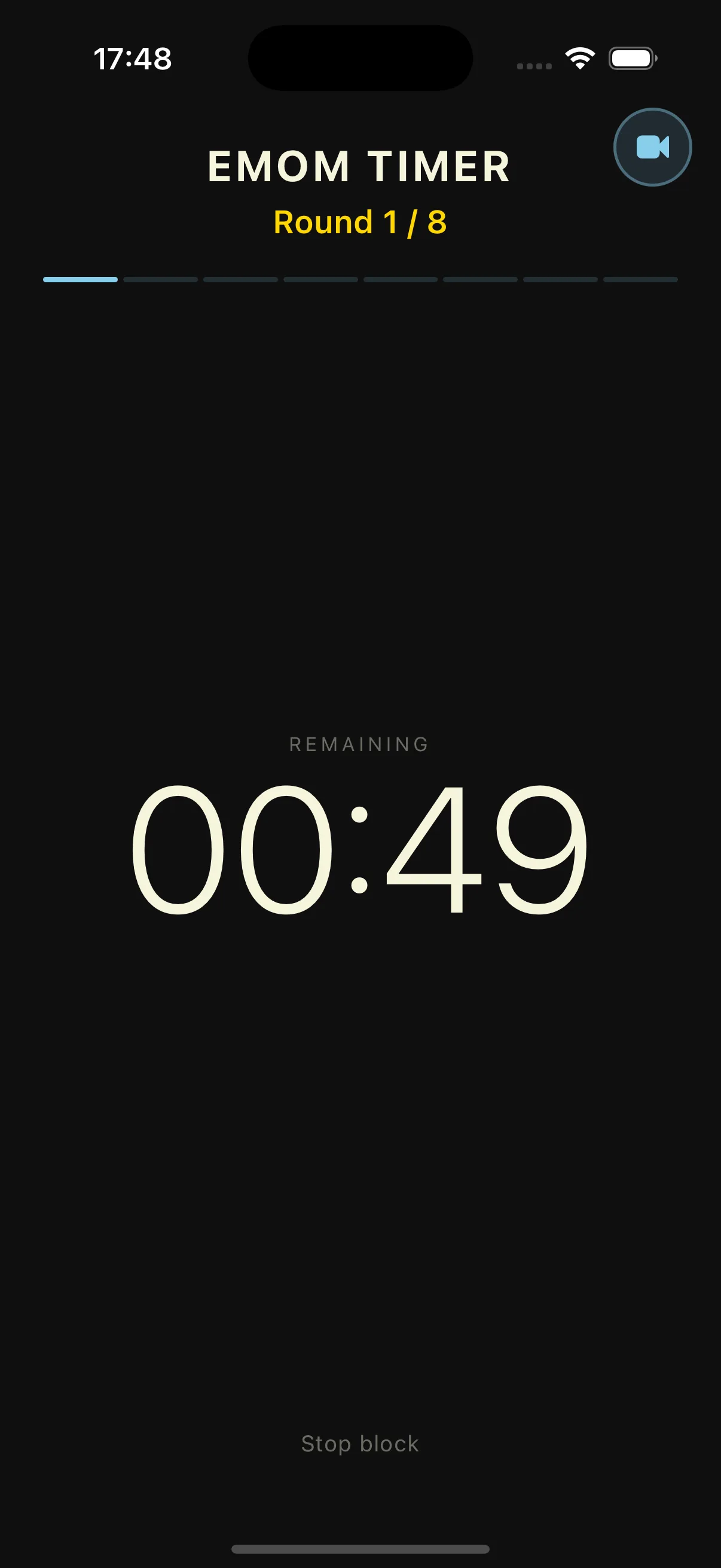
This timer, on your wrist
Here you have to keep the tab open and the phone in your hand. In Evox the WOD runs from your Apple Watch: the active block shows large and transitions buzz at the right moment.
Free, no account, nothing to install. Discover Vox
Everything You Need for Murph
The complete Murph experience with professional timing
The Full Murph Protocol
1 mile run, 100 pull-ups, 200 push-ups, 300 air squats, 1 mile run. For RX, wear a 20/14 lb weighted vest. Complete as prescribed or partition the middle work.
Partition Options
Can't do 100 pull-ups straight? No problem. Partition into 20 rounds of 5 pull-ups, 10 push-ups, 15 squats. Or choose your own partition scheme.
Automatic Timing
Start the timer and focus on the work. EVOX tracks your total time, splits for each section, and saves your result for future comparison.
Scaling Options
New to Murph? Start with Half Murph (half the reps) or scale movements. Ring rows for pull-ups, knee push-ups, and walking instead of running.
The Story Behind Murph
More than a workout - a tribute to a hero
Lieutenant Michael Murphy
Navy SEAL who gave his life in Afghanistan on June 28, 2005. He exposed himself to enemy fire to make a satellite phone call for help, saving his teammates. He was posthumously awarded the Medal of Honor.
Memorial Day Tradition
Every Memorial Day, CrossFit gyms worldwide perform Murph in honor of Lt. Murphy and all fallen service members. Join millions of athletes in this tribute workout.
What's a Good Murph Time?
Elite athletes finish under 35 minutes (RX with vest). 40-50 minutes is competitive. 50-60 minutes is solid for most athletes. Your first Murph? Just finish - the time doesn't matter.
Do Murph with EVOX
From warm-up to final mile, we've got you covered
Load Murph
Open the workout library, find Murph, and choose your version: RX (with vest), as prescribed (no vest), or partitioned.
Set Your Options
Select partition scheme if needed. 20 rounds of 5-10-15 is most common. Or go unpartitioned if you want the full hit.
Honor the Fallen
Hit start and give it everything. Remember why you're doing this. The timer handles the rest - you focus on the work.
Murph Workout FAQ
Common questions about the Murph Challenge
Still have questions?
Contact us →The Complete Murph Workout Guide: History, Strategy, Scaling & Training Plans
Murph is a Hero WOD most boxes run every Memorial Day: 1-mile run, 100 pull-ups, 200 push-ups, 300 air squats, another 1-mile run, traditionally with a 20/14 lb weighted vest. This guide covers the story behind it, strategies for your best time, and how to scale it if you're not ready for the full hit.
Who Was Lieutenant Michael Murphy?
Lieutenant Michael Patrick Murphy was a United States Navy SEAL who gave his life on June 28, 2005, during Operation Red Wings in Kunar Province, Afghanistan. When his four-man reconnaissance team was ambushed by Taliban forces, Murphy deliberately exposed himself to enemy fire to make a satellite phone call for reinforcements. That was the only position with signal reception. He was fatally wounded during the call but succeeded in reaching base, ultimately saving the life of the lone survivor, Marcus Luttrell. Murphy was posthumously awarded the Medal of Honor, the highest military decoration in the United States. His favorite workout, the body armor workout he called Body Armor, was renamed Murph in his honor by the CrossFit community. Every year on Memorial Day, hundreds of thousands of athletes worldwide perform Murph to honor his sacrifice and the sacrifices of all fallen service members. It has become one of the most meaningful traditions in the fitness world.
Partitioned vs Unpartitioned: Choosing Your Strategy
The workout can be performed in two ways: unpartitioned (complete all 100 pull-ups, then all 200 push-ups, then all 300 squats) or partitioned (break the calisthenics into smaller rounds). Unpartitioned Murph is the original standard and is brutally difficult. Very few athletes can complete 100 consecutive pull-ups, so most of the pull-up portion becomes sets of 5-10 with increasing rest. The partitioned approach, most commonly done as 20 rounds of 5 pull-ups, 10 push-ups, and 15 squats (called Cindy rounds), allows for better pacing and is significantly faster for most athletes. Other popular partition schemes include 10 rounds of 10-20-30 or 5 rounds of 20-40-60. The Cindy partition is the most popular because it keeps each set small enough to complete without rest while maintaining a steady pace. EVOX supports both approaches. Select your partition strategy before starting and the app guides you through each round automatically.
Scaling Murph for Every Fitness Level
Murph should be accessible to anyone who wants to participate in the tradition, regardless of fitness level. The most important scaling option is the weighted vest: performing Murph without the vest is still an enormous achievement and is recommended for anyone attempting it for the first time. For pull-ups, ring rows, banded pull-ups, or jumping pull-ups are all valid scaling options. For push-ups, elevating your hands on a box or bench reduces the difficulty while maintaining the movement pattern. Squats can be scaled to a partial range of motion if needed, though most athletes can handle bodyweight squats. Half Murph (a half-mile run, 50 pull-ups, 100 push-ups, 150 squats, and another half-mile run) is an excellent stepping stone. Some athletes even do Quarter Murph as their starting point. The point is to participate, honor the tradition, and challenge yourself at your current level. Every version of Murph is valid, and finishing any version is something to be proud of.
Training Plan: Preparing for Your Best Murph
A solid Murph preparation plan spans 6-8 weeks and targets three areas: running endurance, calisthenics volume, and heat tolerance (since Memorial Day often falls on a warm day). For running, build up to comfortable 2-mile runs at a conversational pace. Your Murph mile splits should be steady, not sprinted. Most athletes should target 8-9 minute miles even if they can run much faster fresh. For calisthenics, practice high-volume sessions twice per week. Start with 5 Cindy rounds (25 pull-ups, 50 push-ups, 75 squats) and add 2-3 rounds per week until you can comfortably complete 15 rounds without excessive fatigue. A Half Murph at 4 weeks out is the perfect dress rehearsal. For pull-up endurance specifically, practice kipping pull-ups in sets of 5-10 with minimal rest to simulate the Murph workload. If you plan to wear a vest, train in it at least 2-3 times before race day so it does not surprise you. On the day itself, start conservative. The athletes who run the first mile too fast always pay for it in the calisthenics.
Ready to Honor the Fallen?
Download EVOX and take on Murph with the perfect timer. Track your time, partition your work, and join millions honoring Lt. Michael Murphy.