
Free Interval TimerFor Any Workout
Customizable work and rest periods for HIIT, circuit training, Tabata, or any interval workout. Launch a quick timer in 2 taps or use it in a full session with camera and tracking.
Round 1 / 8
Work
0:20
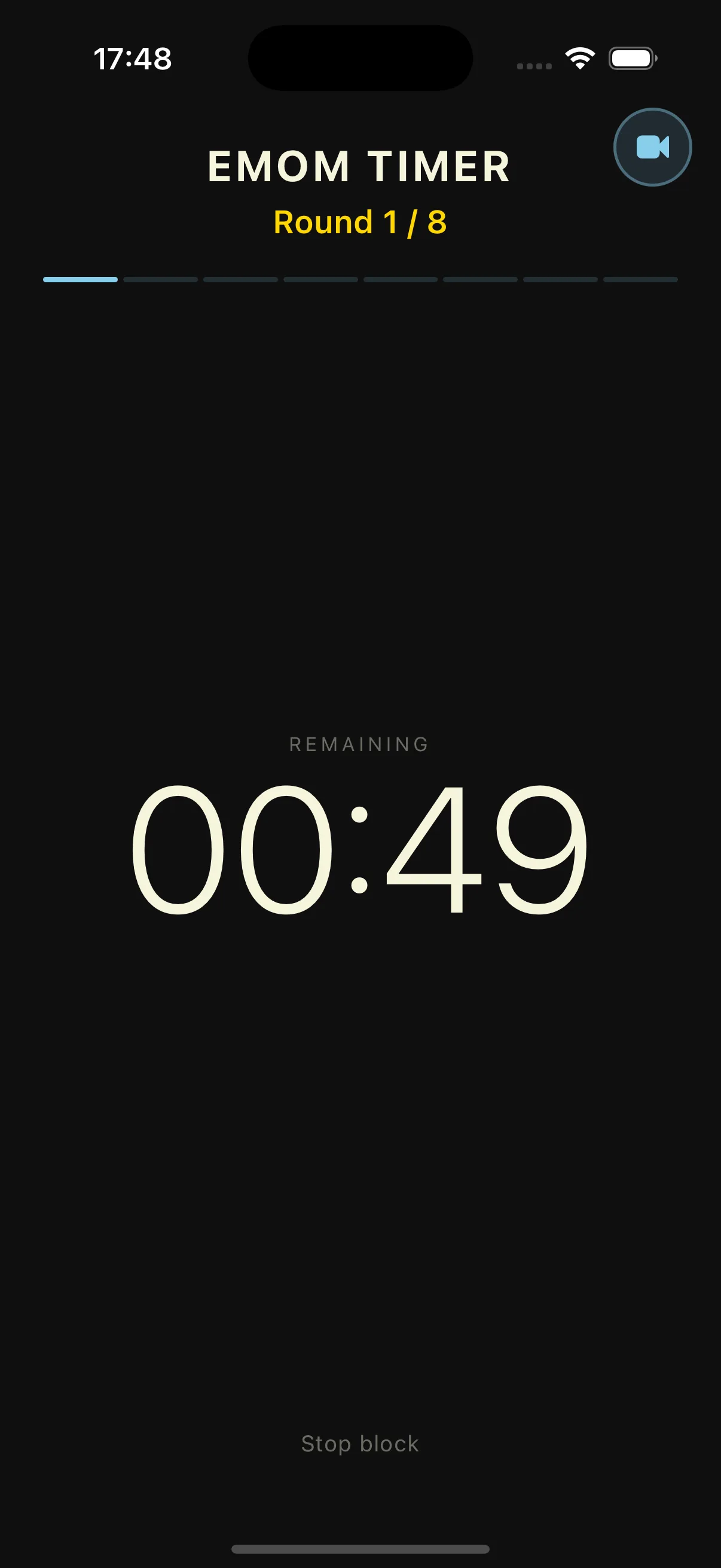
This timer, on your wrist
Here you have to keep the tab open and the phone in your hand. In Evox the WOD runs from your Apple Watch: the active block shows large and transitions buzz at the right moment.
Free, no account, nothing to install. Discover Vox
The Most Flexible Interval Timer
Configure any interval protocol you need
Custom Intervals
Set any work period (10 seconds to 10 minutes) and any rest period. Create the perfect intervals for your specific training needs.
Unlimited Rounds
2 rounds or 100 rounds - set whatever you need. Perfect for short HIIT sessions or long endurance workouts. The timer keeps counting.
Audio Cues
Distinct sounds for work start, rest start, and workout complete. Train without watching the screen. Focus on your movements, not the clock.
Multiple Timer Modes
Beyond custom intervals: use pre-built Tabata (20/10), EMOM (every minute), AMRAP (time cap), or For Time modes. All in one app.
Interval Training For Everyone
Whatever your workout style, intervals make it better
HIIT Workouts
High-intensity interval training burns more calories in less time. Set 30 seconds work / 30 seconds rest and push your limits. Or try 40/20 for extra intensity.
Circuit Training
Move through stations with timed intervals. 45 seconds work, 15 seconds to transition. The timer keeps everyone in sync and moving.
Rest Between Sets
Strength training? Use the timer for consistent rest periods. 90 seconds between heavy sets. 60 seconds for hypertrophy. Never guess your rest again.
Set Up Your Intervals
Flexible configuration, simple execution
Set Work Time
Choose your work period. 20 seconds for Tabata, 30-45 seconds for HIIT, or longer for endurance intervals.
Set Rest Time
Choose your rest period. Short rest (10-20s) for high intensity, longer rest (30-60s) for power or strength work.
Set Rounds & Go
Choose how many rounds. Hit start. The timer guides you through every interval with clear audio and visual cues.
Interval Timer FAQ
Common questions about interval training
Still have questions?
Contact us →The Complete Guide to Interval Training: Work/Rest Ratios, Protocols & Benefits
Interval training is the foundation of nearly every effective fitness protocol, from Tabata and HIIT to CrossFit conditioning and sport-specific preparation. By alternating periods of high-intensity work with structured rest, interval training delivers cardiovascular improvements, fat loss, and performance gains that steady-state cardio simply cannot match. This guide breaks down the science, the protocols, and how to use them effectively.
The Science Behind Interval Training
Interval training works by repeatedly pushing your body above its aerobic threshold and then allowing partial recovery. This cycle triggers adaptations in both the aerobic and anaerobic energy systems simultaneously, something that continuous moderate exercise cannot achieve efficiently. During the high-intensity work period, your muscles rapidly consume oxygen and produce metabolic byproducts like lactate. During the rest period, your body clears these byproducts and begins replenishing energy stores, but the recovery is deliberately incomplete. Over time, your body adapts by increasing mitochondrial density in muscle cells, improving cardiac output, enhancing oxygen delivery to working muscles, and becoming more efficient at clearing lactate. Research consistently shows that interval training improves VO2max (maximum oxygen uptake) more rapidly than steady-state cardio, while also boosting excess post-exercise oxygen consumption (EPOC), the elevated calorie burn that continues for hours after your workout ends. These dual benefits make interval training the most time-efficient approach to improving both fitness and body composition.
Common Interval Protocols Compared
Different work-to-rest ratios target different energy systems and produce different training effects. Tabata (20 seconds work, 10 seconds rest) is the most aggressive protocol. The 2:1 work-to-rest ratio pushes you to absolute maximum intensity for 4 minutes total. It primarily targets anaerobic capacity. The 30/30 protocol (30 seconds work, 30 seconds rest) is a popular 1:1 ratio that balances high intensity with adequate recovery, making it sustainable for 10-20 minutes. It builds both aerobic and anaerobic fitness. The 40/20 protocol (40 seconds work, 20 seconds rest) uses a 2:1 ratio that is slightly more forgiving than Tabata and works well for circuit-style training with multiple exercises. The 60/30 protocol is excellent for strength-endurance work, giving enough time to perform compound movements with moderate loads. For pure aerobic development, longer intervals like 3 minutes work with 2 minutes rest train the body to sustain high output over extended periods. EVOX supports any custom work and rest duration so you can program the exact protocol your training requires.
Interval Training for Different Sports and Goals
The flexibility of interval training makes it applicable across virtually every sport and fitness goal. Runners use intervals to improve speed. Classic track workouts like 400-meter repeats with equal rest are a form of interval training that has produced Olympic champions for decades. Cyclists use Tabata-style efforts on stationary bikes to build peak power output. Combat sports athletes rely on rounds-based intervals (3 minutes work, 1 minute rest) to simulate fight conditions. CrossFit athletes use varied interval protocols to build the broad aerobic base and anaerobic capacity that competition demands. For fat loss, high-intensity intervals burn more calories per minute than any other training method and create the EPOC afterburn effect. For general fitness, intervals keep workouts engaging and time-efficient. 20 minutes of well-structured intervals can deliver more benefit than 45 minutes of steady jogging. The key is matching the protocol to your specific goals, and EVOX makes it effortless to configure any interval structure you need.
How to Structure Your Interval Workouts for Maximum Results
Effective interval programming follows a few essential principles. First, intensity must be genuine. If you can hold a conversation during your work periods, you are not working hard enough. True intervals should push you to 85-95% of maximum heart rate during work periods. Second, respect the rest periods. Shortening rest to seem tougher actually reduces the quality of subsequent work intervals, leading to lower total training volume and diminished adaptation. Third, choose exercises that allow you to maintain intensity throughout. Assault bike, rowing, running, kettlebell swings, burpees, and bodyweight movements are excellent choices. Avoid technically demanding movements where form degrades under fatigue. Save those for EMOM-style work with more recovery. Fourth, periodize your interval training. Start with longer rest ratios (1:1 or even 1:2) and progressively reduce rest over weeks as fitness improves. A sample progression might be 30/30 for two weeks, then 30/20, then 40/20, then 30/15. EVOX lets you save different interval configurations as presets, making it easy to follow a structured progression without reconfiguring settings each session.
Ready to Level Up Your Training?
Download EVOX and get a flexible interval timer. Custom intervals, audio cues, and the features you need. Free.